Web Agentic
web-agentic
The @basis-theory/web-agentic package verifies Agentic Payments allowances in the customer's browser. It drives the Verify Allowance state machine, renders the customer prompts, runs the provider ceremonies, and resolves only after the API reports the selected rail active.
The SDK is framework-agnostic and has no runtime dependencies. Use it with plain JavaScript, React, Vue, Angular, or another browser framework.
For the complete payment flow around verification, start with the Agentic Payments Implementation Guide.
Before You Begin
Create a public application with agentic:allowance:verify. Public keys are designed for browser use.
Your application also needs:
- An allowance whose
railispending_verification - The exact
providerfrom that rail - An HTTPS top-level origin with popups enabled
- A browser environment that allows hosted iframes
- A Content Security Policy whose
connect-srcpermits the selected Agentic Payments API origin
Installation
- npm
- Yarn
- pnpm
- CDN
npm install @basis-theory/web-agentic
yarn add @basis-theory/web-agentic
pnpm add @basis-theory/web-agentic
<script
  src="https://js.basistheory.com/web-agentic/<VERSION>/index.js"
  integrity="<INTEGRITY_HASH>"
  crossorigin="anonymous"
></script>
Releases publish to immutable versioned paths, so pin the version you tested. There is no latest alias, and a path without a version does not resolve. Use 1.2.0 or later — earlier bundles put the factory directly on window.BasisTheoryAgentic, and the examples below do not apply to them.
The integrity attribute lets the browser reject a bundle whose bytes changed, and crossorigin="anonymous" is required for the browser to run that check. Each version publishes its hash at https://js.basistheory.com/web-agentic/<VERSION>/sri.json; copy the value under integrityHashes into integrity.
If your application enforces a Content Security Policy, its script-src must also permit https://js.basistheory.com. This applies only to the CDN bundle.
The script defines window.BasisTheoryAgentic, an object carrying the same names the package exports: AgenticVerification, collectDeviceContext, and every error class in Handle Errors. Wherever the package examples import, destructure instead:
const { AgenticVerification, ApiError } = window.BasisTheoryAgentic;
Initialization
Create one instance for the page or component lifecycle:
- ES Module
- CDN
import { AgenticVerification } from "@basis-theory/web-agentic";

const agenticVerification = AgenticVerification({
  apiKey: "<PUBLIC_API_KEY>",
  displayName: "Example Agent",
});
const { AgenticVerification } = window.BasisTheoryAgentic;

const agenticVerification = AgenticVerification({
  apiKey: "<PUBLIC_API_KEY>",
  displayName: "Example Agent",
});
Production uses https://api.basistheory.com/agentic by default. A test tenant uses the test API:
const agenticVerification = AgenticVerification({
  apiKey: "<PUBLIC_API_KEY>",
  apiBaseUrl: "https://api.test.basistheory.com/agentic",
  displayName: "Example Agent",
});
Verify an Allowance
Pass the allowance ID and the exact rail and provider pair returned by the allowance:
const result = await agenticVerification.verifyAllowance("<ALLOWANCE_ID>", {
  rail: "agentic-token",
  provider: "vic",
});

console.log(result);
// { status: "active", rail: "agentic-token", provider: "vic" }
The SDK serializes calls on each instance. A second verifyAllowance call while one is active rejects rather than running two ceremonies against the same UI and browser resources. Calling it for an already-active rail resolves without contacting the provider.
Customize the UI
The built-in UI renders in a Shadow DOM and includes method selection, OTP entry, provider-ceremony confirmations, waiting and progress states, retry prompts, errors, and success.
These are the principal states with the default appearance; the error states are shown in Handle Errors:
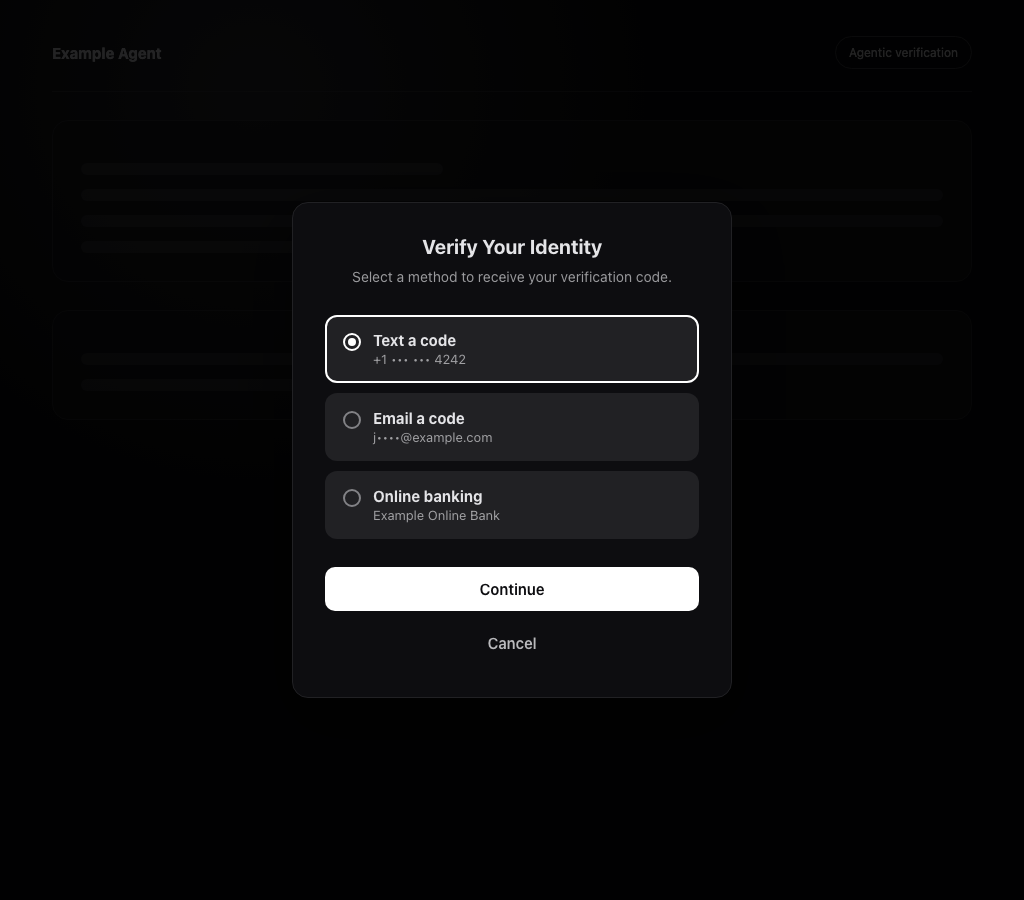 1Method selection
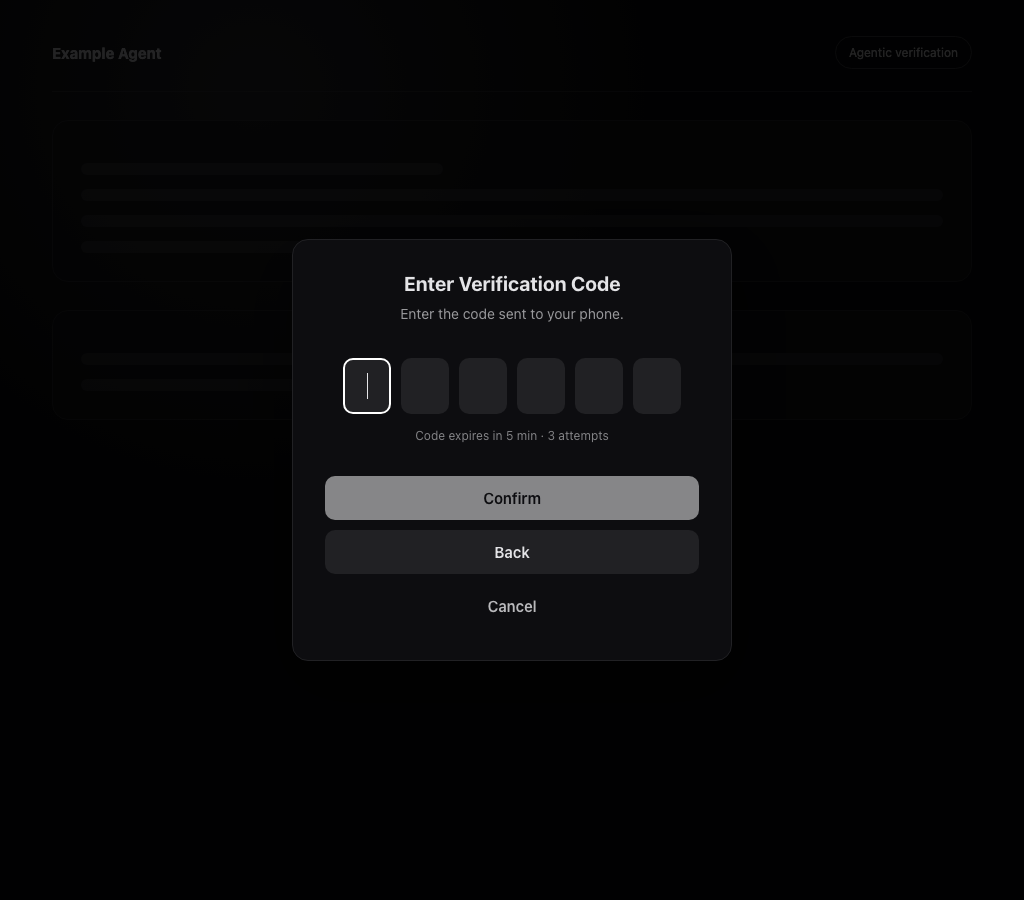 2OTP entry
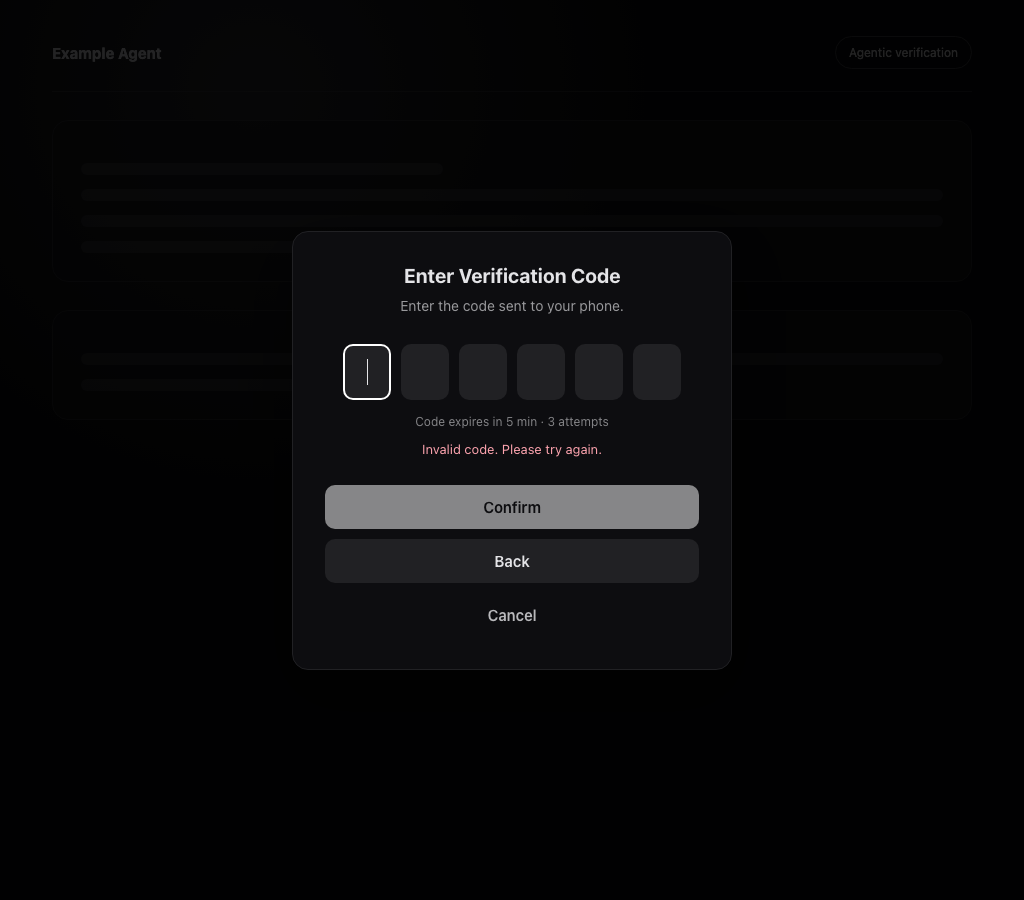 3Invalid code retry
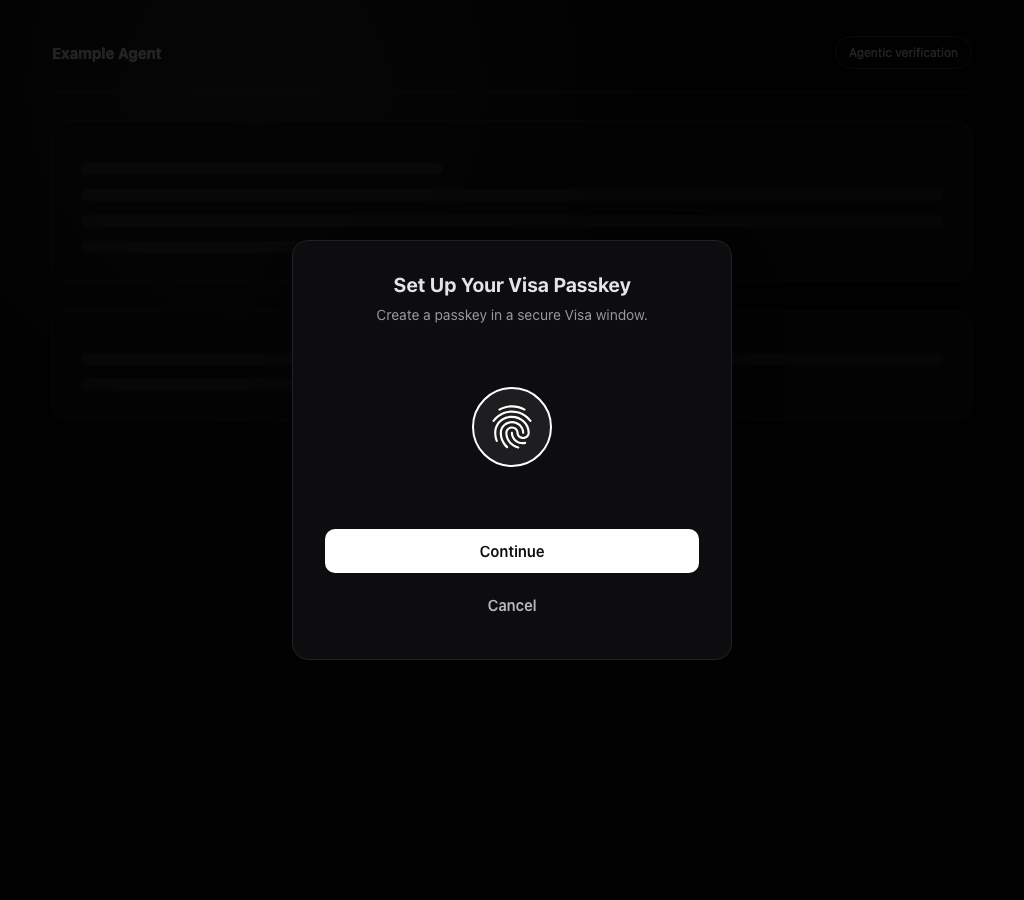 4Visa ceremony confirmation
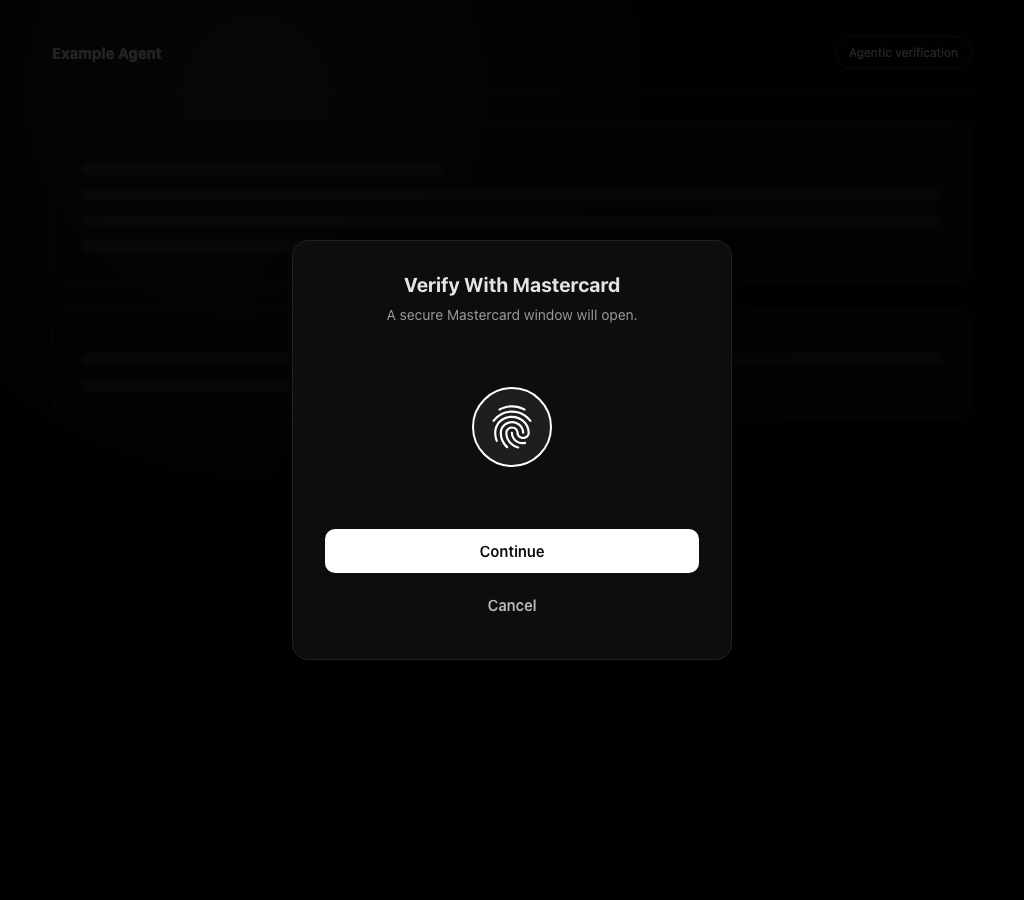 5Mastercard ceremony confirmation
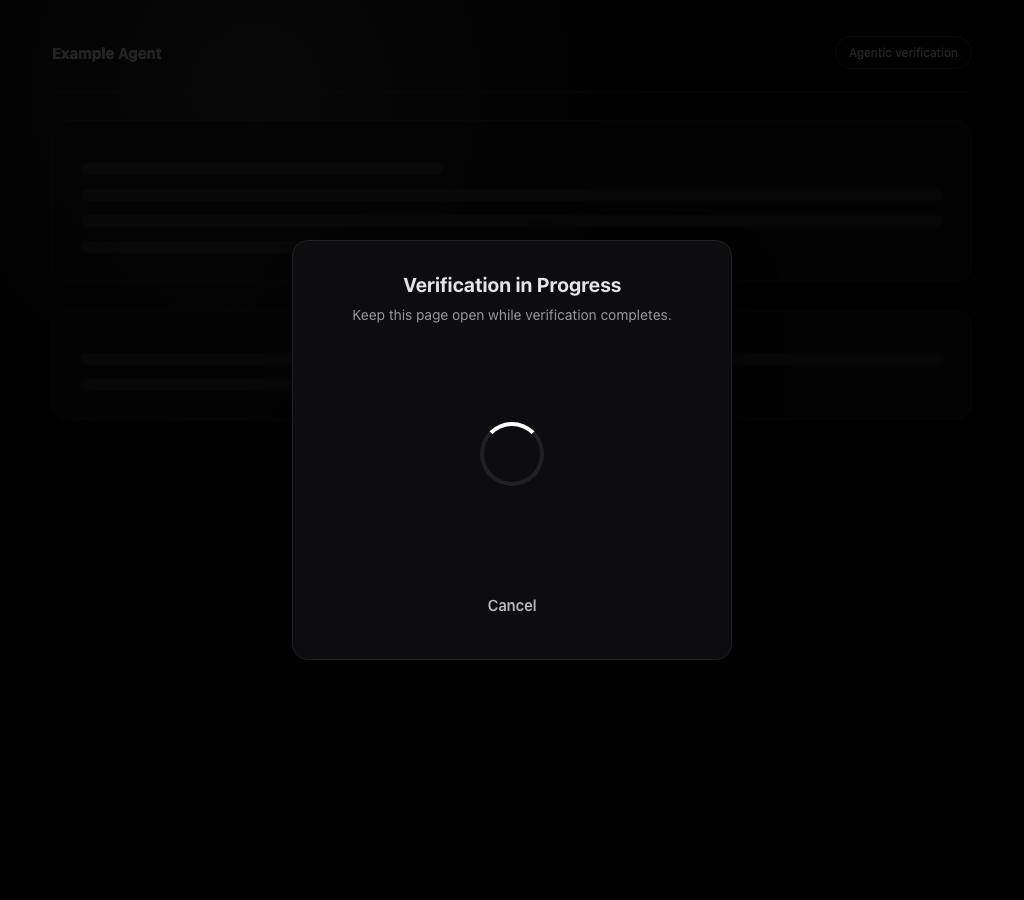 6Progress
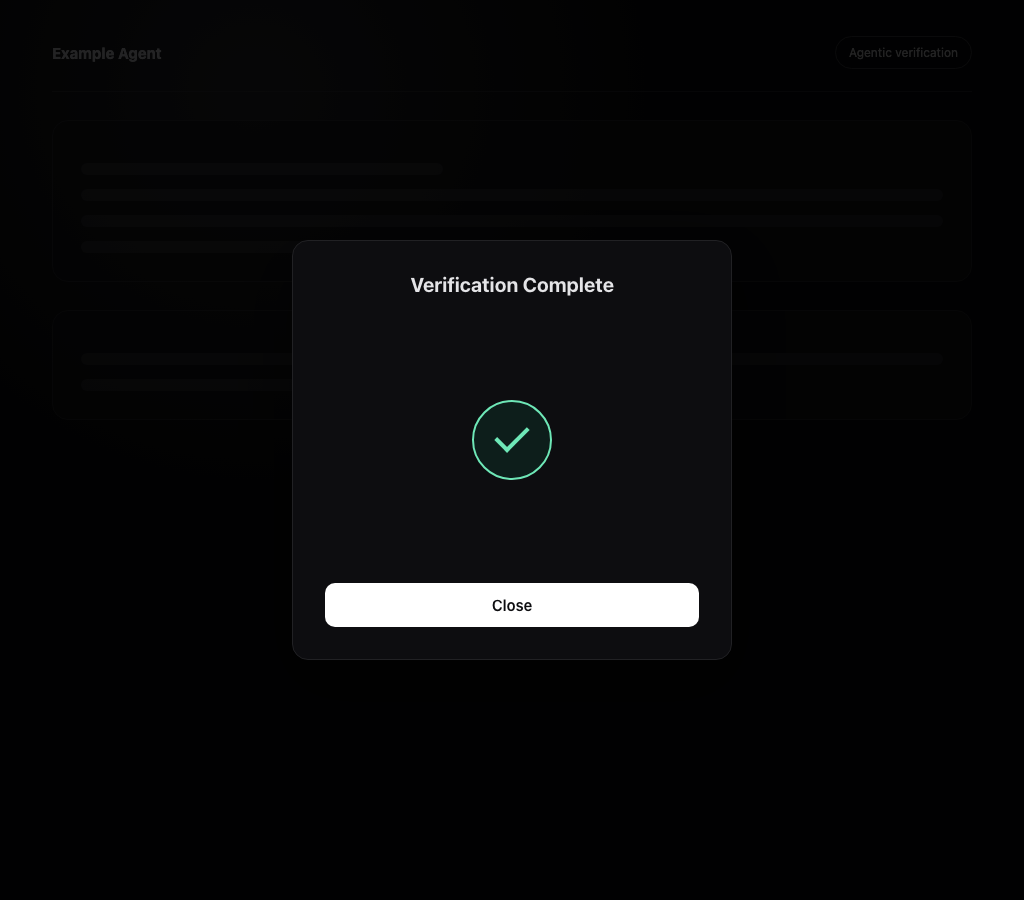 7Success
Appearance and Copy
Set six CSS colors with appearance. All values must be valid CSS colors.
const agenticVerification = AgenticVerification({
  apiKey: "<PUBLIC_API_KEY>",
  appearance: {
    primaryColor: "#1d4ed8",
    secondaryColor: "#e5e7eb",
    backgroundColor: "#ffffff",
    fontColor: "#111827",
    successColor: "#15803d",
    errorColor: "#b91c1c",
  },
});
| Property | Controls |
|---|---|
primaryColor | Primary buttons, selected methods, focused OTP boxes, and spinner accent |
secondaryColor | Method cards, OTP boxes, secondary buttons, and spinner track |
backgroundColor | Modal surface |
fontColor | Headings, labels, buttons, and derived muted text |
successColor | Anything that represents successful operations |
errorColor | Anything that represents operations in error |
Override user-facing text with strings:
const agenticVerification = AgenticVerification({
  apiKey: "<PUBLIC_API_KEY>",
  strings: {
    methodSelectTitle: "Confirm your identity",
    otpTitle: "Enter the code we sent",
    continueButton: "Continue securely",
    successTitle: "You're verified",
  },
});
Placeholders in built-in strings, such as {minutes} and {attempts} in otpHint, remain available to localized overrides.
Replace Individual Prompts
Keep ui: true and pass one or more handlers to replace only the prompts your application owns:
const agenticVerification = AgenticVerification({
  apiKey: "<PUBLIC_API_KEY>",
  handlers: {
    collectOtp: ({ method, maxAttempts, attempt, error }) =>
      openYourOtpDialog({ method, maxAttempts, attempt, error }),
  },
});
The built-in UI continues to render every step without an override, plus waiting, progress, retry, error, and success states.
Bring Your Own UI
Set ui: false and provide a handler for every prompt. The SDK still owns the API state machine.
function confirmWithButton({ network, openPopup }) {
  return new Promise((resolve, reject) => {
    const button = document.createElement("button");
    button.type = "button";
    button.textContent = `Continue with ${network}`;

    button.addEventListener(
      "click",
      () => {
        button.remove();
        try {
          resolve(openPopup());
        } catch (error) {
          reject(error);
        }
      },
      { once: true },
    );

    document.body.append(button);
  });
}

const agenticVerification = AgenticVerification({
  apiKey: "<PUBLIC_API_KEY>",
  ui: false,
  handlers: {
    selectOtpMethod: async (methods) => showMethodPicker(methods),
    collectOtp: async ({ method, maxAttempts, attempt, error }) =>
      showOtpInput({ method, maxAttempts, attempt, error }),
    confirmCeremony: confirmWithButton,
  },
});
The helper is intentionally minimal; render the control in your own dialog or component. Its ordering is mandatory: confirmCeremony must call openPopup() synchronously inside the click listener. Browser user activation ends when that listener returns, including after an await. Returning true without opening the popup is rejected with ConfigurationError.
selectOtpMethod returns a method ID. Treat each method's masked value as opaque display text. Returning null, returning undefined, or throwing from that handler cancels selection. collectOtp returns the code and is called again with error set after INVALID_OTP; return null or undefined to cancel code entry. confirmCeremony cancels when it returns null or false without opening.
Headless mode has no built-in retry prompt: a retryable failure rejects the verifyAllowance promise, and your application decides whether to call it again.
Use with React
No React wrapper is required. Keep one instance for the component lifecycle and dispose it on unmount. JSX needs a build step, so this example uses the package rather than the CDN bundle:
import { AgenticVerification } from "@basis-theory/web-agentic";
import { useEffect, useMemo, useState } from "react";

function VerifyButton({ allowanceId, rail, provider, publicApiKey }) {
  const [error, setError] = useState(null);
  const agenticVerification = useMemo(
    () => AgenticVerification({ apiKey: publicApiKey }),
    [publicApiKey],
  );

  useEffect(
    () => () => agenticVerification.dispose(),
    [agenticVerification],
  );

  async function verify() {
    setError(null);
    try {
      await agenticVerification.verifyAllowance(allowanceId, {
        rail,
        provider,
      });
    } catch (verificationError) {
      setError(verificationError);
    }
  }

  return (
    <>
      <button onClick={verify}>Verify allowance</button>
      {error && <p role="alert">{error.message}</p>}
    </>
  );
}
Factory Options
AgenticVerification(options) returns collectDeviceContext, verifyAllowance, and dispose.
| Option | Type | Default | Description |
|---|---|---|---|
apiKey | string | None | Public key with agentic:allowance:verify. Required unless verify is provided |
apiBaseUrl | string | https://api.basistheory.com/agentic | Agentic Payments API base URL |
displayName | string | Agent | 1 to 60 characters shown on the provider's ceremony screens |
platformType | string | WEB | Forwarded in device context. Common values are WEB, MOBILE, and NATIVE |
ui | boolean | true | Set to false when all prompts use custom handlers |
appearance | object | Dark palette | Built-in UI colors |
strings | object | English copy | User-facing string overrides |
handlers | object | None | Mixed or headless prompt handlers |
otpLength | number | 6 | Number of OTP entry boxes in the built-in UI |
openRedirect | (uri) => void | Browser popup | Launch override for redirect ceremonies (e.g. Mastercard) in webviews or native shells |
completePollAttempts | number | 10 | Poll attempts for ceremonies that finish through complete (e.g. Mastercard) |
completePollDelayMs | number | 2000 | Delay between complete poll attempts in milliseconds |
requestTimeoutMs | number | 30000 | Timeout for each built-in API request in milliseconds |
onEvent | (event) => void | None | Receives state_change, ceremony_open, restart, error, and success events |
verify | function | Built-in public transport | Custom verification transport for backend routing |
getAllowance | function | None | Optional private allowance read for provider discovery and final refresh with a custom transport |
bridgeOrigins | string[] | Basis Theory API origins plus apiBaseUrl | Origin allowlist for ceremony callback messages (e.g. Mastercard's callback bridge). Override only for an API origin you control |
verifyAllowance Options
| Option | Type | Default | Description |
|---|---|---|---|
provider | vic or agentpay | None | Required with the built-in public transport |
rail | string | agentic-token | The only rail with a browser ceremony. Any other value is rejected with ConfigurationError |
displayName | string | Factory value | Per-call display-name override |
timeoutMs | number | 300000 | Overall ceremony budget in milliseconds |
signal | AbortSignal | None | Cancels the active verification |
The promise resolves to { status, rail, provider, allowance? }. The built-in public transport cannot read allowances, so allowance is present only when a custom private getAllowance transport completes the optional final refresh.
Collect Device Context
collectDeviceContext(overrides?) returns the object the SDK sends with start. client_device_id is stable per device using local storage, with an in-memory fallback, and client_reference_id is new on every call. language_code and time_zone are omitted when the browser cannot report a valid value.
The browser cannot reliably discover its public IP address or outgoing Accept header, so the SDK never invents ip_address or accept_header. If a custom backend transport adds them, use an IPv4 address and the browser's actual Accept value.
Calling collectDeviceContext() yourself does not mutate the next SDK-managed request. Use its return value only when a custom transport needs to merge backend-supplied fields.
Route API Calls Through Your Backend
The direct public-key transport is the default. If policy requires Agentic API calls to pass through your backend, provide verify and optionally getAllowance. Both receive the active AbortSignal; preserve it in your fetch so cancellation and the overall ceremony timeout still work.
- ES Module
- CDN
import {
  AgenticVerification,
  ApiError,
} from "@basis-theory/web-agentic";

async function readOrThrow(response) {
  if (response.ok) return response.json();

  const problem = await response.json().catch(() => null);
  throw new ApiError(
    problem?.detail ?? `Agentic API returned ${response.status}`,
    {
      status: response.status,
      problem,
      traceId: response.headers.get("bt-trace-id") ?? undefined,
    },
  );
}

const agenticVerification = AgenticVerification({
  displayName: "Example Agent",
  verify: async (allowanceId, body, { signal } = {}) => {
    const response = await fetch(
      `/api/agentic/allowances/${encodeURIComponent(allowanceId)}/verify`,
      {
        method: "POST",
        headers: { "Content-Type": "application/json" },
        body: JSON.stringify(body),
        signal,
      },
    );
    return readOrThrow(response);
  },
});
const { AgenticVerification, ApiError } = window.BasisTheoryAgentic;

async function readOrThrow(response) {
  if (response.ok) return response.json();

  const problem = await response.json().catch(() => null);
  throw new ApiError(
    problem?.detail ?? `Agentic API returned ${response.status}`,
    {
      status: response.status,
      problem,
      traceId: response.headers.get("bt-trace-id") ?? undefined,
    },
  );
}

const agenticVerification = AgenticVerification({
  displayName: "Example Agent",
  verify: async (allowanceId, body, { signal } = {}) => {
    const response = await fetch(
      `/api/agentic/allowances/${encodeURIComponent(allowanceId)}/verify`,
      {
        method: "POST",
        headers: { "Content-Type": "application/json" },
        body: JSON.stringify(body),
        signal,
      },
    );
    return readOrThrow(response);
  },
});
The application-owned backend route must authenticate the browser, forward the body to the Agentic Payments Verify Allowance endpoint with a server-held key carrying agentic:allowance:verify, and return the Problem Details body plus bt-trace-id. The provider ceremonies still run in the browser; a custom transport changes only the API hop.
Dispose the Instance
Call dispose() when the owning page or component unmounts:
agenticVerification.dispose();
Disposal aborts an active run and removes every SDK-owned iframe, popup, message listener, timer, and UI host; for a run in flight, that teardown completes as the run settles. dispose() is idempotent and leaves the instance usable, so a remount (React StrictMode, Fast Refresh) can call verifyAllowance again immediately without awaiting the aborted run.
Handle Errors
SDK errors extend AgenticVerificationError. API errors use the RFC 7807 response type as an open set and preserve the bt-trace-id header as traceId.
The built-in terminal-error screen shows customer-safe copy only. API error codes, HTTP statuses, field errors, and trace IDs never reach it — read them from the rejected promise's ApiError, or from onEvent. In-progress states render a Cancel button that aborts the verification, and Escape does the same; success and terminal-error states render a Close button that dismisses the modal without changing the result. There is no separate close icon.
The built-in UI renders three kinds of error state: a recoverable inline message on the ceremony prompt (for example, a blocked popup), a retryable error with a Try Again button, and a terminal error with only Close:
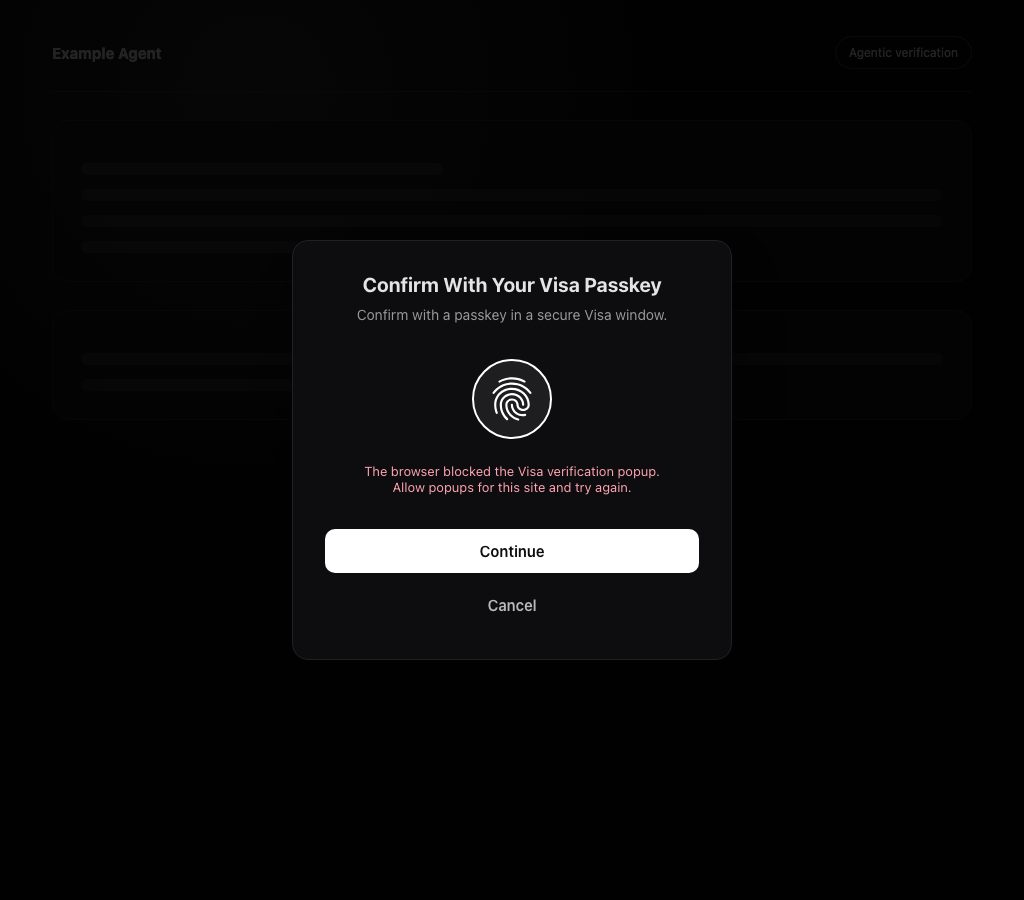 1Recoverable: popup blocked
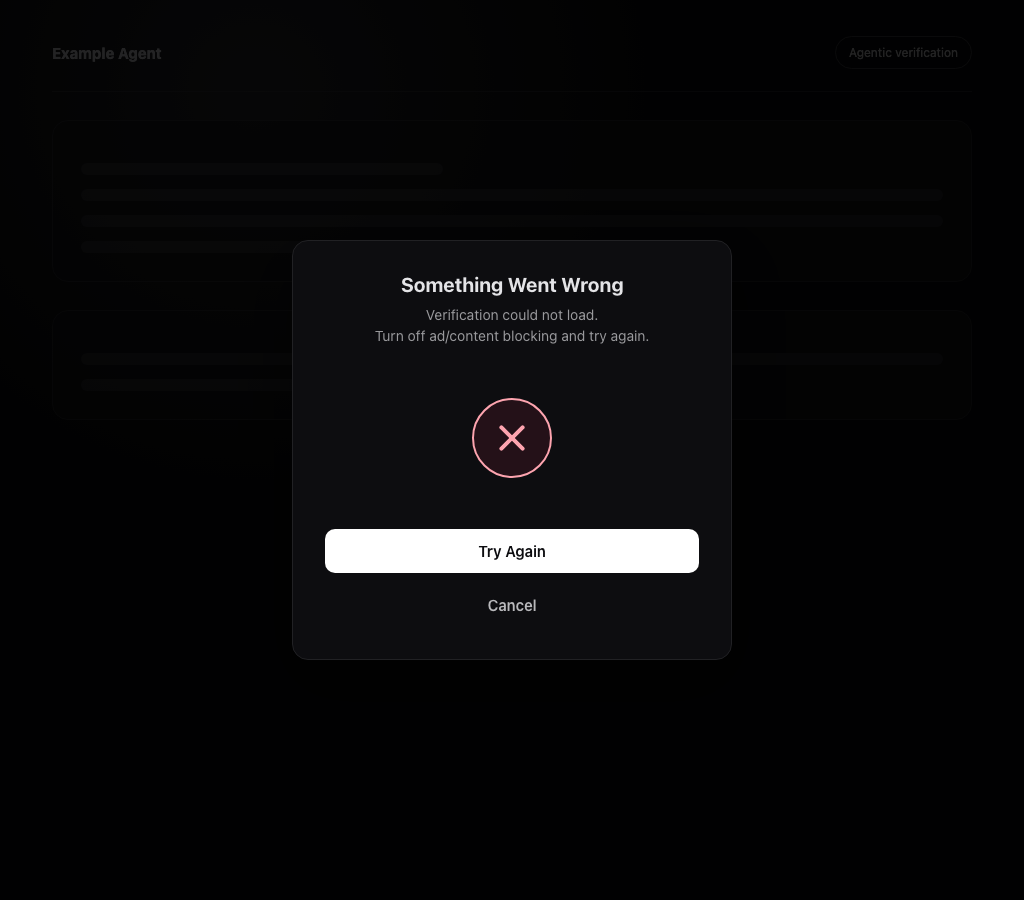 2Retryable error
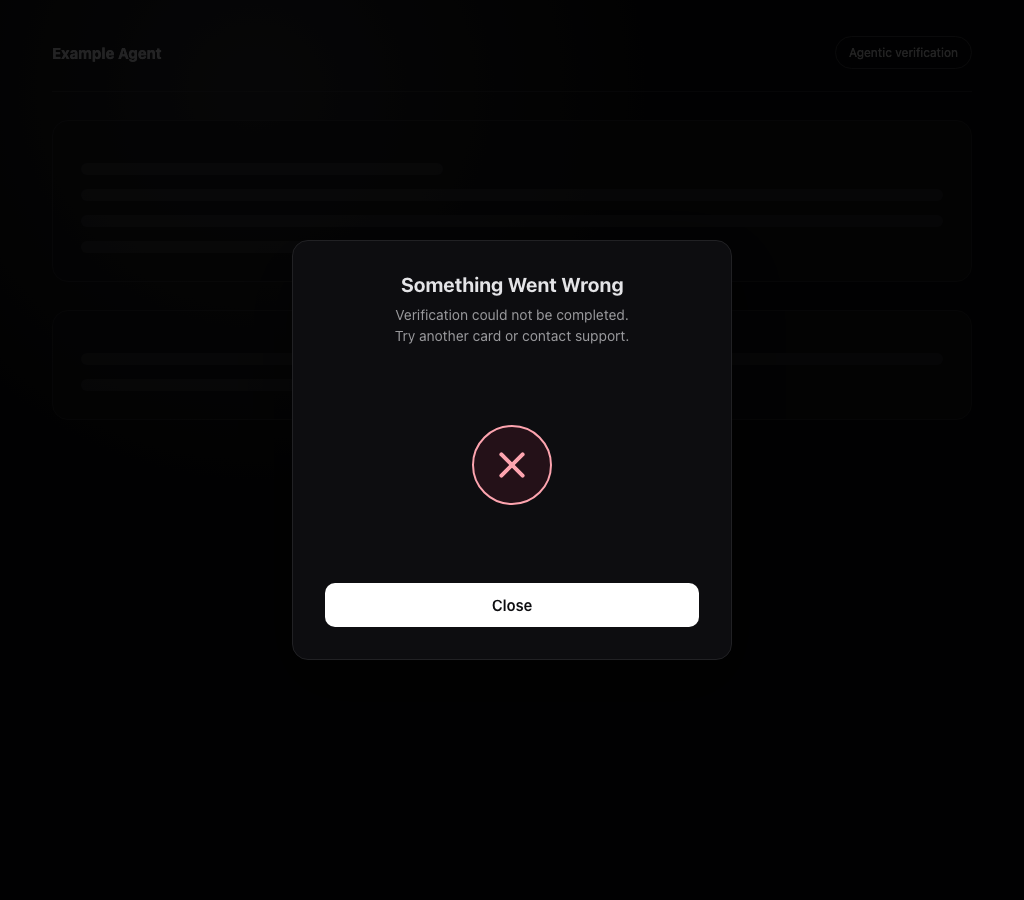 3Terminal error
- ES Module
- CDN
import {
  ApiError,
  PopupBlockedError,
  VerificationCancelledError,
  VerificationNotSupportedError,
} from "@basis-theory/web-agentic";

try {
  await agenticVerification.verifyAllowance("<ALLOWANCE_ID>", {
    rail: "agentic-token",
    provider: "vic",
  });
} catch (error) {
  if (error instanceof VerificationCancelledError) {
    showTryAgainLater();
  } else if (error instanceof PopupBlockedError) {
    askCustomerToAllowPopups();
  } else if (error instanceof VerificationNotSupportedError) {
    offerAnotherActiveRailOrPaymentMethod();
  } else if (error instanceof ApiError) {
    console.error(error.type, error.status, error.traceId);
  }
}
const {
  ApiError,
  PopupBlockedError,
  VerificationCancelledError,
  VerificationNotSupportedError,
} = window.BasisTheoryAgentic;

try {
  await agenticVerification.verifyAllowance("<ALLOWANCE_ID>", {
    rail: "agentic-token",
    provider: "vic",
  });
} catch (error) {
  if (error instanceof VerificationCancelledError) {
    showTryAgainLater();
  } else if (error instanceof PopupBlockedError) {
    askCustomerToAllowPopups();
  } else if (error instanceof VerificationNotSupportedError) {
    offerAnotherActiveRailOrPaymentMethod();
  } else if (error instanceof ApiError) {
    console.error(error.type, error.status, error.traceId);
  }
}
| Error | Meaning |
|---|---|
ApiError | Basis Theory Problem Details response or a synthetic NETWORK_ERROR |
VerificationCancelledError | The customer or an AbortSignal cancelled the run |
PopupBlockedError | The browser blocked the ceremony window |
PopupClosedError | A ceremony window closed before completion (e.g. the Visa popup) |
CeremonyTimeoutError | The overall run, an API request, a hosted frame, or a completion poll exceeded its budget. For a hosted-frame timeout (e.g. Visa's), check ad/content blockers, privacy tools, browser security settings, network filtering, and CSP frame-src |
VerificationNotSupportedError | The source cannot complete verification on the selected rail |
ConfigurationError | The SDK options or integration contract are invalid |
Network failures such as offline, DNS, TLS, or CORS errors have no HTTP response. They surface as ApiError with status: 0, type: "NETWORK_ERROR", and no trace ID.
The SDK's retry behavior is deterministic:
API type | Built-in SDK behavior |
|---|---|
INVALID_OTP | Keeps the same code-entry step open and calls collectOtp again with the error |
Any 409 ending in _IN_PROGRESS | Retries the same action four times with bounded exponential backoff; built-in UI then offers a restart |
VERIFICATION_STATE_INVALID | Restarts once automatically; a repeat is offered through built-in retry UI |
PROVIDER_VERIFICATION_FAILED | Built-in UI offers a restart from start; headless mode rejects |
VERIFICATION_NOT_SUPPORTED | Rejects with terminal VerificationNotSupportedError for this rail |
Any other 409 | Rejects without retrying |
NETWORK_ERROR | Built-in UI offers a restart; headless mode rejects the retryable ApiError |
| Any other type | Rejects with terminal ApiError |
Include traceId when contacting Basis Theory Support. Treat API error types as an open set and do not automatically retry an unknown type.
Browser Support
The SDK supports current Chrome, Edge, and Firefox, plus Safari 16.4 or newer. It supports iOS Safari and Android Chrome; ceremony popups may appear as new tabs on mobile.
For a native shell or webview, set platformType to MOBILE or NATIVE. Mastercard can use openRedirect to launch an authentication session or custom tab because the SDK treats the callback message only as a cue and still polls complete. Visa requires a WebAuthn-capable webview loading your HTTPS page and allowing its hosted iframe; fully native Visa ceremonies are not supported by this SDK.
Test the Integration
Use a test tenant and set:
apiBaseUrl: "https://api.test.basistheory.com/agentic";
Test-tenant ceremonies use Basis Theory-hosted mocks of the provider ceremonies, speaking the production message protocols with no provider traffic. See Agentic Payments Testing for the test card numbers and failure scenarios.
Own the Protocol
The SDK is the recommended path even when your application supplies every visual prompt. If you must also own the verification state machine, iframe and popup protocols, origin and source validation, polling, and cleanup, follow Own the Browser Verification Flow.