Triggering 3DS
Decide, for each customer-initiated payment, whether 3DS is mandated by regulation or worth running for your own risk posture.You hold a token intent for a card the customer just entered, or a token for a card they saved earlier, and you are about to authorize. Before you do, you have to answer two questions that are usually asked as one. Is authentication mandated for this payment? And if it is not, do you want it anyway? The first is decided by regulation, and it depends on where the card was issued and where your merchant account is acquired. The second is yours, and it is a trade-off between liability shift and friction.
This guide covers both questions for Customer-Initiated Transactions (CIT), where the cardholder is present and can complete a challenge. Merchant-Initiated Transactions sit outside these mandates. See the MIT implementation guide for those.
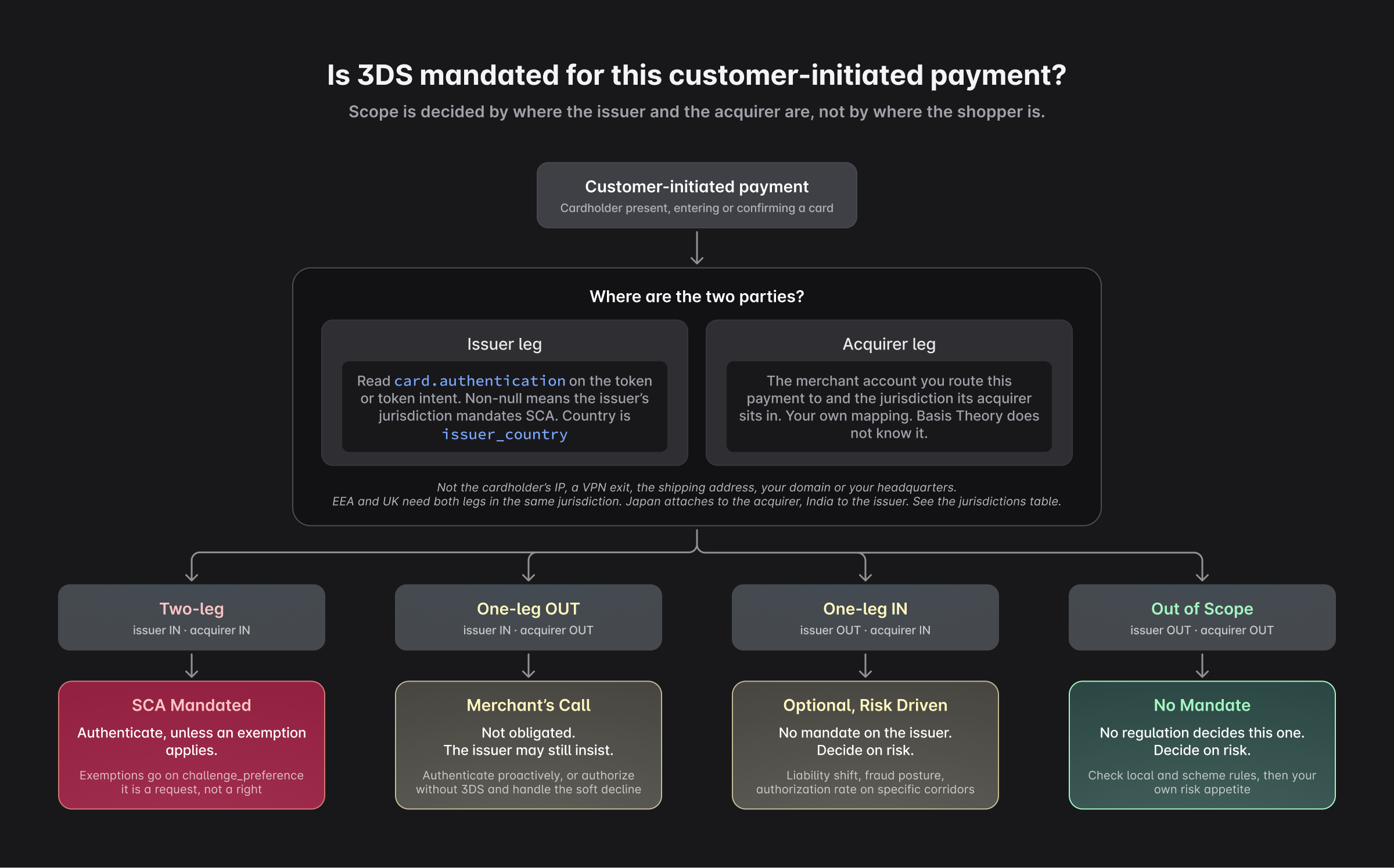
Is 3DS Mandated?
Regulations that mandate Strong Customer Authentication (SCA) attach to the parties in the payment, not to the shopper. Each regime decides which party it binds. The European Economic Area (EEA) and the United Kingdom bind both the card issuer and your acquirer, and only when both are inside the same area. Japan binds the acquirer, India the issuer, and Australia either one once a fraud threshold is breached. Brazil has no regulator rule at all; its card industry body sets the floor instead. The table maps each onto the two legs. In every case you need two facts: where the card was issued, and where the merchant account you are routing to is acquired.
| Region | Attaches to | What it requires | Source |
|---|---|---|---|
| 🇪🇺 EEA | Both the issuer and the acquirer | SCA on every customer-initiated remote electronic payment, unless an exemption applies. The issuer decides whether to grant an exemption. | Delegated Regulation (EU) 2018/389, the RTS on SCA under PSD2, and the EBA's one-leg guidance |
| 🇬🇧 United Kingdom | Both the issuer and the acquirer. The UK and the EEA are separate jurisdictions, so a UK acquirer with an EEA issuer is one-leg. | Same structure as the EEA, with sterling thresholds. | FCA SCA-RTS and FCA Approach Document, chapter 20 |
| 🇯🇵 Japan | The acquirer leg: e-commerce merchants accepting credit cards in Japan | EMV 3DS on e-commerce credit card payments, in place since the end of March 2025. Issuers must enroll their cardholders. | Credit Card Security Guidelines, Credit Transaction Security Council, under METI's Installment Sales Act supervision |
| 🇮🇳 India | The issuer leg: cards issued in India | At least two authentication factors, one of them dynamic, on every domestic card-not-present payment. From 1 October 2026, Indian issuers must also validate authentication on cross-border card-not-present payments when the overseas acquirer requests it. | RBI Authentication Mechanisms for Digital Payment Transactions Directions, 2025 |
| 🇦🇺 Australia | Issuers and acquirers in Australia, conditionally | Not a blanket mandate. SCA becomes required for an issuer or a merchant whose card-not-present fraud rate stays above the framework's thresholds for consecutive quarters. | AusPayNet CNP Fraud Mitigation Framework |
| 🇧🇷 Brazil | Neither leg by regulation. Industry self-regulation through Abecs binds issuers and acquirers, and merchants are reached through their acquirer. | No Banco Central do Brasil or CMN rule requires authentication for card-not-present card payments. Abecs Normativo 31, in effect since February 2025, has merchants request EMV 3DS above per-merchant-category ticket floors and exempts recurring, card-on-file, corporate and anonymous prepaid payments. Below the floor, 3DS is optional and the scheme liability shift is the incentive. | Abecs 3DS program |
Saudi Arabia's mada scheme requires 3DS for mada cards online, which is a scheme rule rather than a regulator mandate. The United States, Canada and Mexico have no regulator mandate for card-not-present payments. There, the card networks' liability shift is the incentive to authenticate, not a legal requirement.
Mandates change and acquirers interpret them differently. Confirm with your acquirer what applies to each merchant account, and treat this table as the starting point rather than the final word.
Scope follows the two parties and nothing else. Do not decide it on the cardholder's IP address, a VPN exit country, the shipping or billing address, the storefront's domain, or where your company is headquartered. Each of those is wrong often enough to cause declines in one direction and unnecessary challenges in the other.
The issuer leg
Basis Theory gives you this one. Every card token and token intent carries a card.issuer_country field with the issuing country, and a sibling card.authentication field set to sca_required when that country's regulator mandates authentication, and null otherwise. When the BIN is not recognized, both fields come back null together. A null country means the issuer side is unknown, not out of scope.
{
  "id": "d2cbc1b4-5c3a-45a3-9ee2-392a1c475ab4",
  "type": "card",
  "card": {
    "bin": "424242",
    "last4": "4242",
    "brand": "visa",
    "funding": "credit",
    "authentication": "sca_required",
    "issuer_country": {
      "alpha2": "GB",
      "name": "UNITED KINGDOM OF GREAT BRITAIN AND NORTHERN IRELAND",
      "numeric": "826"
    }
  }
}
Treat sca_required as "the issuer's regulator requires authentication". The field says nothing about how the issuer will respond to a 3DS request, and nothing about your acquirer. The country is what you compare against your acquirer's; the flag is what tells you the issuer may still insist on authentication when your acquirer is out of scope.
Fetch the token or token intent server-side before you read either field. A card object posted from the browser can be edited by anyone with the developer tools open, so the browser is never the place to decide whether authentication is required.
The acquirer leg
You own this one. Basis Theory does not know which acquirer sits behind each of your merchant accounts, and no field on the token can tell you. Keep a mapping from each merchant account to the country its acquirer is licensed in, and keep it next to your routing logic. Routing has to choose the merchant account before you can decide on authentication. Australia's conditional thresholds are a conversation with your acquirer, so record their answer in the same mapping.
The same record is a good home for the acquirer-issued credentials you send as merchant_info and requestor_info when you authenticate the session. The MID and acquirer BIN are issued per network, and often per currency, so key them that way and keep the network-specific requestor fields next to the network they belong to. The merchant name, category code and URL are the same for every network and sit at the account level. At authentication time, pick the card's network and the payment's currency and assemble the API objects from this record.
// One entry per merchant account, maintained by you. `country` is where the acquirer is licensed.
const merchantAccounts = {
  "acme-eu": {
    country: "NL",
    merchant: { name: "Acme", category_code: "5734", url: "https://acme.example" },
    networks: {
      visa: {
        EUR: { mid: "<MID>", acquirer_bin: "<ACQUIRER_BIN>" },
        PLN: { mid: "<MID>", acquirer_bin: "<ACQUIRER_BIN>" },
      },
      mastercard: { EUR: { mid: "<MID>", acquirer_bin: "<ACQUIRER_BIN>" } },
      cartes_bancaires: {
        EUR: { mid: "<MID>", acquirer_bin: "<ACQUIRER_BIN>" },
        siret_number: "<SIRET_NUMBER>",
      },
    },
  },
  "acme-uk": {
    country: "GB",
    merchant: { name: "Acme", category_code: "5734", url: "https://acme.example" },
    networks: { visa: { GBP: { mid: "<MID>", acquirer_bin: "<ACQUIRER_BIN>" } } },
  },
  "acme-jp": {
    country: "JP",
    merchant: { name: "Acme", category_code: "5734", url: "https://acme.example" },
    networks: { jcb: { JPY: { mid: "<MID>", acquirer_bin: "<ACQUIRER_BIN>" } } },
  },
  "acme-au": {
    country: "AU",
    scaRequired: true, // set when your acquirer tells you a fraud threshold was breached
    merchant: { name: "Acme", category_code: "5734", url: "https://acme.example" },
    networks: { visa: { AUD: { mid: "<MID>", acquirer_bin: "<ACQUIRER_BIN>" } } },
  },
  "acme-us": {
    country: "US",
    merchant: { name: "Acme", category_code: "5734", url: "https://acme.example" },
    networks: {
      visa: { USD: { mid: "<MID>", acquirer_bin: "<ACQUIRER_BIN>" } },
      amex: {
        USD: { mid: "<MID>", acquirer_bin: "<ACQUIRER_BIN>" },
        requestor_type: "MER",
      },
      discover: {
        USD: { mid: "<MID>", acquirer_bin: "<ACQUIRER_BIN>" },
        client_id: "<DISCOVER_CLIENT_ID>",
      },
    },
  },
};
Combining the two legs
Each regime in the table reads the two legs its own way. Japan looks only at the acquirer, India only at the issuer, Australia at whichever party breached its threshold. The EEA and the UK are the ones that need both, and they are separate areas: an EEA-issued card routed to a UK acquirer is one-leg, not two-leg. For those two, the combination of the legs decides the obligation.
| Issuer | Acquirer | Obligation | What to do |
|---|---|---|---|
| In scope | In scope | Two-leg. SCA applies. | Authenticate, unless an exemption applies. |
| In scope | Out of scope | One-leg out. You are not obligated. The issuer's regulator expects it to apply SCA where it can, so the issuer may still require it. | Authenticate proactively, or authorize and handle the soft decline (for example, authentication_required). |
| Out of scope | In scope | One-leg in. No mandate on the issuer. | Optional. Decide on risk. |
| Out of scope | Out of scope | No mandate. | Optional. Decide on risk. |
The function below is a starting point for your own rules. It encodes the regulator mandates from the table and returns one of four outcomes: unknown when the BIN was not recognized, mandated, issuer_may_insist for one-leg-out payments, and optional. Scheme and industry rules, such as Abecs floors in Brazil or mada in Saudi Arabia, reach you through your acquirer, so add them as your acquirer tells you they apply.
const EEA = new Set(["AT", "BE", "BG", "HR", "CY", "CZ", "DK", "EE", "FI", "FR", "DE", "GR", "HU", "IS", "IE", "IT", "LV", "LI", "LT", "LU", "MT", "NL", "NO", "PL", "PT", "RO", "SK", "SI", "ES", "SE"]);

function authenticationRequirement(card, acquirer) {
  // Unknown BIN. Enrichment found nothing, so the issuer side is unknown, not out of scope.
  if (!card.issuer_country) return "unknown";

  const issuer = card.issuer_country.alpha2;

  // EEA and UK: both parties inside the same area. The two areas do not combine.
  if (EEA.has(issuer) && EEA.has(acquirer.country)) return "mandated";
  if (issuer === "GB" && acquirer.country === "GB") return "mandated";

  // Japan: the mandate sits on merchants acquired in Japan, whatever the card.
  if (acquirer.country === "JP") return "mandated";

  // India: domestic payments only. Indian cards routed abroad fall through.
  if (issuer === "IN" && acquirer.country === "IN") return "mandated";

  // Australia: only once your acquirer tells you a fraud threshold was breached.
  if (acquirer.country === "AU" && acquirer.scaRequired) return "mandated";

  // Nothing mandates it. If the issuer's regulator expects SCA, the issuer may still insist.
  return card.authentication === "sca_required" ? "issuer_may_insist" : "optional";
}

const { card } = await client.tokenIntents.get(tokenIntentId);
const requirement = authenticationRequirement(card, merchantAccounts[selectedMerchantAccount]);
Exemptions When 3DS Is Mandated
In the EEA and UK, an exemption lets a two-leg payment skip authentication. An exemption is a request, not a right. Your acquirer decides which exemptions you are eligible for, and the issuer can refuse any of them and demand a challenge. Liability for fraud stays with whoever asked for the exemption, so an exempted payment does not carry liability shift.
| Exemption | EEA | UK | How you request it |
|---|---|---|---|
| Low value | At most €30 per payment, and at most €100 or five payments since the cardholder's last SCA | At most £25, and at most £85 or five payments | Your acquirer flags it in the authorization. No 3DS session is involved. The issuer keeps the counters and may refuse. |
| Transaction risk analysis (TRA) | Up to €100, €250 or €500 depending on whether the acquirer's fraud rate is below 0.13%, 0.06% or 0.01% | Up to £85, £220 or £440 at the same rates | Two ways. Your acquirer can flag TRA in the authorization with no 3DS session, and you authenticate only if the issuer soft-declines. Or run 3DS with challenge_preference set to no-challenge-risk-analysis-performed, which asks the issuer up front and gives you a result to carry into the authorization. |
| Trusted beneficiary | The cardholder lists you with their issuer. Later payments skip SCA. | Same | no-challenge-whitelist-exemption. To offer enrollment during a challenge, use challenge-requested-whitelist-prompt. |
| Recurring, fixed amount | SCA on the first payment only. Later MITs sit outside scope. | Same | Authenticate the first CIT. See the MIT guide for the rest of the series. |
| Secure corporate payment | Lodged and virtual corporate cards paid through dedicated processes | Same | Arranged with your acquirer. No 3DS request. |
The thresholds above are the RTS on SCA and FCA SCA-RTS values in force as of November 2026. Mail order and telephone order payments are outside scope altogether and are not an exemption.
The exemption preferences, values 05 through 09 in the challenge preference table, require 3DS 2.2.0 and are available in the live environment only. In the sandbox, use no-challenge in their place.
Request a TRA exemption on the Authenticate Session call by setting challenge_preference.
curl 'https://api.basistheory.com/3ds/sessions/<SESSION_ID>/authenticate' \
  -X 'POST' \
  -H 'BT-API-KEY: <PRIVATE_API_KEY>' \
  -H 'Content-Type: application/json' \
  --data '{
    "authentication_category": "payment",
    "authentication_type": "payment-transaction",
    "challenge_preference": "no-challenge-risk-analysis-performed",
    "merchant_info": {
      "mid": "<MERCHANT_ID>",
      "acquirer_bin": "<ACQUIRER_BIN>",
      "name": "<MERCHANT_NAME>",
      "category_code": "<MERCHANT_CATEGORY_CODE>",
      "country_code": "<MERCHANT_COUNTRY_CODE>",
      "url": "<MERCHANT_URL>"
    },
    "purchase_info": {
      "amount": "4999",
      "currency": "EUR",
      "exponent": "2",
      "date": "20261101141010",
      "transaction_type": "purchase"
    }
  }'
If the issuer does not challenge, the result usually comes back as informational rather than successful. The cardholder was not authenticated, so there is no authentication value and liability_shifted is false. That status does not confirm the exemption. The exemption is granted or refused at authorization, so authorize with it flagged the way your acquirer expects and read the authorization result. If the issuer insists on authenticating, the result comes back as challenge and you run the challenge as described in the CIT implementation guide. Either way, read liability_shifted on the result before you treat the payment as covered.
Should You Trigger 3DS Anyway?
When nothing mandates authentication, the question becomes what 3DS buys you. A successful authentication, frictionless or challenged, can move fraud chargeback liability from you to the issuer, and it gives the issuer more data to approve with. Success alone does not guarantee the shift: check liability_shifted on the result before treating the payment as covered. Against that, a challenge adds a step that some cardholders abandon, and in markets without a mandate some issuers treat a 3DS request as a risk signal or challenge most attempts.
Merchants settle on one of two postures. Both are legitimate, and large merchants often run one in mandated markets and the other everywhere else.
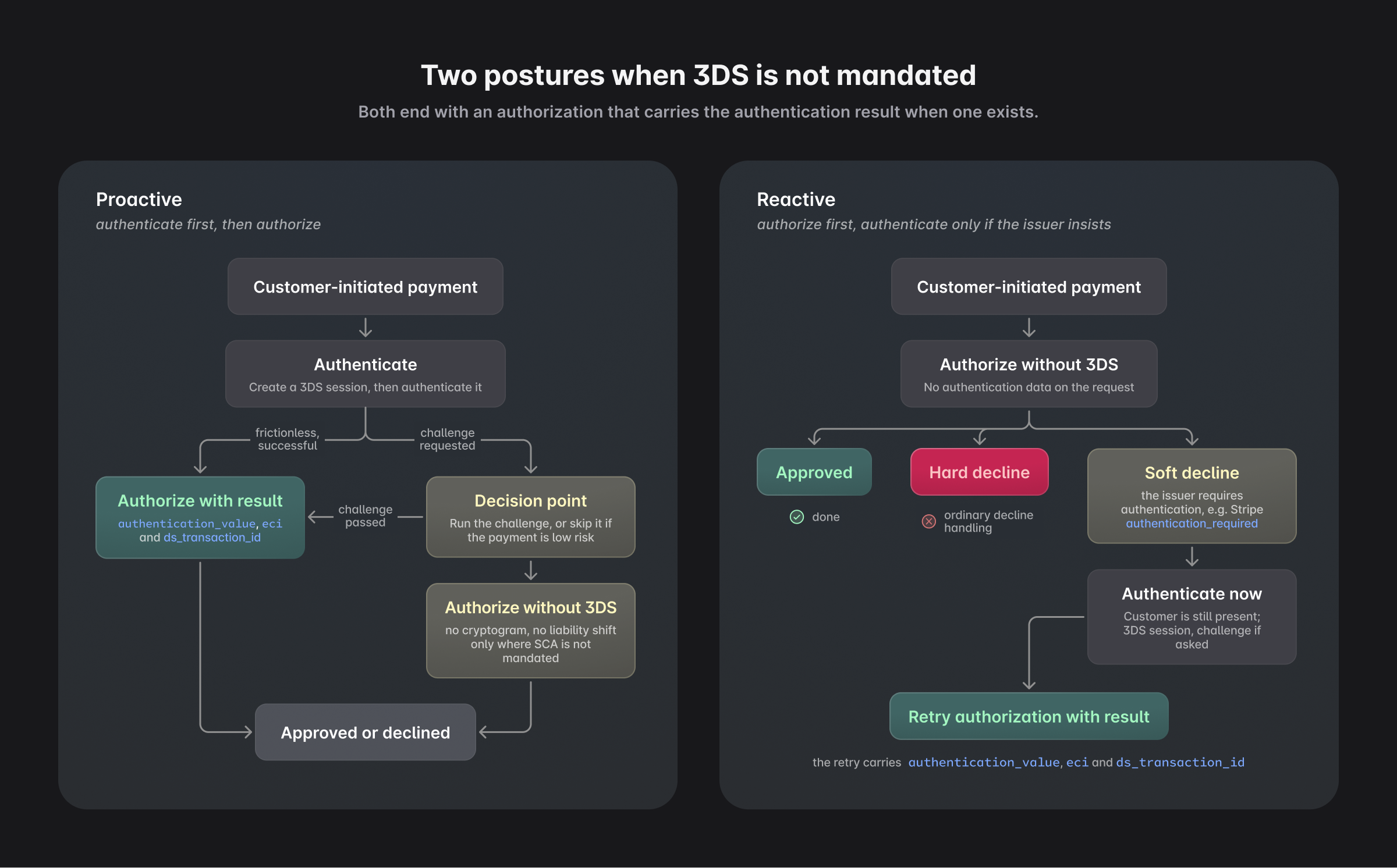
Proactive. Authenticate first, then authorize carrying the result. It is one rule for every processor, it is easy to reason about, and it is the only option where SCA is mandated. The cost is friction you did not need. A common refinement is to authenticate, authorize with the result when it comes back frictionless, and treat a challenge as a decision point rather than an instruction: for a low-risk payment that is not mandated, you can authorize without the authentication data and accept the liability instead of showing the challenge.
Reactive. Authorize without authentication. If the issuer declines because it requires authentication, run 3DS while the customer is still on the page and retry with the result. Friction lands only where the issuer insists, which is why most merchants choose this posture for one-leg-out payments and for markets with no mandate. It costs more engineering. Each processor names the decline differently (Stripe, for example, returns authentication_required), your checkout has to keep the customer and the order alive across the retry, and the worst case is two authorization round trips.
let result = await psp.authorize({ token, amount, merchantAccount });

if (result.declineReason === "authentication_required") {
  // The issuer will not approve without SCA. The customer is still present.
  const session = await runThreeDs({ tokenId: token.id, amount, merchantAccount });

  if (["successful", "attempted"].includes(session.authentication_status)) {
    result = await psp.authorize({
      token,
      amount,
      merchantAccount,
      threeDs: {
        cryptogram: session.authentication_value,
        eci: session.eci,
        dsTransactionId: session.ds_transaction_id,
      },
    });
  }
}
Merchants that authenticate selectively usually key on a few signals: a new card on a new account, an amount well above the customer's history, a BIN or sales channel with elevated chargebacks, or a cardholder with prior disputes. Whatever the trigger, leave challenge_preference at no-preference unless you have a specific reason to set it. The issuer decides whether to challenge, and a preference is a hint it is free to ignore.
Before You Authorize
Whichever posture you choose, enforce it server-side. Fetch the token or token intent, apply the two-leg rule, and require a 3DS result on the authorization whenever either leg demands one. Then pass the result to your processor. Taking 3DS Live shows the field mapping for Adyen, Stripe, Checkout.com and the EMVCo field names for everyone else. The CIT implementation guide covers creating and authenticating the session itself.
FAQ
Can Basis Theory tell me whether my merchant account's region requires 3DS?
No. card.issuer_country and card.authentication describe the issuer side. Where your acquirer is licensed is a fact about your merchant account that only you and your acquirer hold. Keep that mapping yourself and combine it with the token's flag.
Is sca_required enough on its own to decide?
No. It is the issuer leg only. Acting on it alone makes you authenticate every one-leg-out payment, which is a defensible but conservative choice, and it tells you nothing about one-leg-in payments, where your acquirer is in scope and the card is not.
Should I run 3DS before authorizing, or only after a decline?
Both work. Where SCA is mandated, authenticate first. Elsewhere, authenticating after an authentication-required decline keeps friction to the payments where the issuer insists, at the cost of a second authorization round trip and processor-specific decline handling. The postures section covers the trade-off.
Can I test exemptions in the sandbox?
No. Challenge preferences 05 through 09 are live-only. Use no-challenge in the sandbox to exercise a no-challenge path, and switch to the exemption value when you go live. The challenge preference table lists what the sandbox supports.
Does a fixed-amount subscription need 3DS on every charge?
No. Authenticate the customer-initiated payment that sets up the series. Later charges of the same amount to the same payee are Merchant-Initiated Transactions and fall outside SCA. A change of amount can bring a charge back into scope, and how that is handled depends on your acquirer. See the MIT guide.
What happens when the issuer does not support 3DS or the authentication fails?
The session result tells you which case you are in. The authentication response section of the CIT guide explains each status. Where SCA is mandated, there is no cryptogram to send and the issuer will decline the authorization, so there is nothing to retry. Where it is not, you decide whether to authorize without authentication and carry the liability.
Does PSD3 change any of this?
Not yet. The Payment Services Regulation that will replace PSD2 keeps SCA and had not entered into force as of November 2026. When it applies, this page will be updated.